The 2025 Shake-Up: How the UCI’s License Renewal Could Reshape Women’s Pro Cycling

The 2025 Shake-Up: How the UCI’s License Renewal Could Reshape Women’s Pro Cycling

If professional women’s cycling were a soap opera—which, with all the drama, breakaways, and unexpected plot twists, it kind of is—then 2025 is the season finale that’s going to leave everyone breathless. And not because of a last-lap pileup or a surprise sprinter victory. Nope. This time, the tension isn’t coming from the finish line, but from the back offices of the Union Cycliste Internationale (UCI), where teams are sweating over spreadsheets, audited financials, and compliance checklists. Welcome to the UCI Women’s WorldTour license renewal process: the ultimate off-the-bike race for survival.

The 2025 season marks the final year of the current licensing cycle, and what happens in the coming months will determine which teams get to race at the highest level starting in 2026. But this isn’t just another rubber-stamp renewal. For the first time, licenses will be awarded for a three-year cycle (2026–2028), meaning the UCI is playing the long game—and they’re demanding that teams prove they’re not just fast on the road, but stable, equitable, and professionally run off it.

So, what does this mean? Teams aren’t being judged solely by their wins at the Tour de France Femmes or Strade Bianche anymore. Instead, they’re being measured by staff ratios, prize money transparency, and financial solvency. It’s like if the Oscars started demanding proof that Best Picture nominees actually paid their crew living wages. Noble? Absolutely. Stressful? You bet.

And here’s the kicker: failure isn’t just falling off the front on Alpe d’Huez. It’s demotion to the UCI Women’s Continental level, a funding crisis, or even total collapse. With stakes this high, the 2025 license renewal isn’t just paperwork—it’s a reckoning.

Image

The Evolution of the Women’s WorldTour

Rewind to 2016. The women’s peloton had just received its biggest upgrade since bike shorts replaced bloomers: the UCI Women’s WorldTour. It was a step forward, replacing the old Elite Women Road program with a structured, top-tier circuit featuring 15 of the best teams. Finally, women’s races like the Giro Rosa (now Giro d’Italia Donne) and the newly revitalized Spring Classics had real prominence.

But let’s be real: early days were messy. Licensing standards were loose. Teams like Boels-Dolmans (now SD Worx-Protime) and Rabobank (later Liv Racing) ran tight ship with solid budgets, but many others were essentially passion projects—held together by duct tape, social media clout, and the occasional generous benefactor. Riders often paid for their own travel insurance, bikes, and sometimes even race entries.

Fast forward to the 2020s, and the game changed. The Tour de France Femmes launched in 2022 to a standing ovation—and massive TV ratings—proving that women’s cycling wasn’t just viable, it was exciting. Stars like Demi Vollering (SD Worx-Protime), Lotte Kopecky (SD Worx and then Lidl-Trek), and Lorena Wiebes (Soudal–Quick-Step) became household names, and teams began adding performance staff, proper media strategies, and long-term contracts.

But success brought scrutiny. The pressure to professionalize intensified. Riders, agents, and advocates like Marion Rousse (director of the Tour de France Femmes) began calling for better pay, benefits, and safeguards. And in 2024, the UCI responded with new minimums: rider salaries, contract durations, and health coverage requirements.

Now, in 2025, the baton passes to the next level of professionalism—one that’s less about individual excellence and more about institutional integrity.

Why License Renewal Matters

This isn’t just about handing out stickers. License renewal shapes the entire ecosystem.

A WorldTour license gives teams automatic entry into the sport’s biggest races—the Tour de France Femmes, La Vuelta Femenina, Itzulia Women—and access to media rights and sponsor exposure. Lose it, and even if your riders are talented, you’re stuck begging for wildcard invites or watching races on TV.

More importantly, stability attracts sponsors. No corporation wants to fund a team that might vanish mid-season. So the UCI is essentially asking: Are you a serious business, or just a cycling hobby?

And with the new three-year award cycle starting in 2026, the message is clear: if you want in, you better be built to last 2.

The 2025 Evaluation: Key Requirements

The New Equity Benchmarks

Starting in 2026, UCI Women’s WorldTour teams must meet a new set of equity and professionalism standards—no exceptions. These aren’t suggestions. They’re non-negotiable, and teams have all of 2025 to prove they comply.

Let’s break down the big three.

  1. Equal Prize Money Distribution

    The UCI’s 2024 regulatory update (Document ROA-20250401) mandates that prize money earned at UCI-sanctioned events must be distributed transparently and fairly among riders—and equally across genders if the team fields both men’s and women’s squads 6. No more “team bonuses” mysteriously favoring certain riders. No more vague handouts. Everything must be documented and reported.

    For example, if SD Worx-Protime (a joint men’s/women’s team under the Lidl-Trek umbrella) wins €50,000 in prize money at the Tour de France Femmes, that money must be split according to a clear, pre-approved formula—one that mirrors how their male counterparts are paid, if applicable.

    This is long overdue. For years, female riders have earned a fraction of men’s prize pools, even at co-sanctioned events. Now, the UCI is making sure the money hits rider bank accounts—not just the team director’s overhead.

  2. Staff-to-Rider Ratios

    Remember when a team had one soigneur doing massages, cooking, laundry, and bike repairs? Those DIY days are, in theory, over.

    New rules require a minimum 1:3 staff-to-rider ratio. For an 18-rider team, that means six full-time non-riders: coaches, sports directors, mechanics, soigneurs, nutritionists, and—newly recommended—mental health professionals.

    Teams like FDJ-Suez have already upped their game, hiring performance psychologists and full-time chefs 4. But for lower-budget teams like Ceratizit-WNT or Uno-X Women’s Team, adding even two more full-time staff could mean €200,000–€300,000 in new annual expenses 7.

    It’s a tall order—but also a smart one. A well-supported rider is a stronger, safer, and more sustainable one.

  3. Financial Stability Thresholds

    No more “We’ll figure it out in January” funding. The UCI wants proof of long-term solvency.

    By October 31, 2025, all teams must submit audited financials showing:

    A minimum annual budget of €1.2 million 7

Three-year sponsorship contracts (with verified signatures)

All riders on UCI-compliant contracts, paying at least €38,000 per year

Yes, you read that right. The minimum salary jumped from €20,000 just a few years ago to nearly double 7. Good news for riders, yes—but another financial mountain for smaller teams.

Controversy & Challenges

The “Survival of the Richest” Dilemma

You’d think that more equity, better pay, and stronger teams would be universally celebrated. But in pro cycling, progress sometimes looks a lot like exclusion.

Smaller, independent teams are raising the alarm. “We’re committed to professionalism,” said an unnamed manager for Ceratizit-WNT in a Cyclingnews interview in late 2024, “but the new staff ratio alone could cost us 15% of our budget. Where does that money come from?”

That’s the central tension: the UCI is demanding big changes, but women’s pro cycling still earns just 12% of the sponsorship revenue of men’s teams, despite comparable viewership growth.

Manufacturers like Trek (Lidl-Trek), Jumbo-Visma (Team Visma | Lease a Bike), and SD Worx-Protime can absorb the costs. But regional sponsors backing teams like EF Education-Cannondale or Cofidis Women Team? Not so much.

The Sponsorship Gap

Let’s talk dollars. The best UCI Women’s WorldTour teams now run on budgets around €3–5 million. Sounds like a lot—until you learn that top men’s teams spend 10 times that.

And while brands like Agriturismo Il Vicino, Uno-X, and Cofidis have stepped up, their budgets are tight. Without bigger investment, some teams may have no choice but to merge—or fold.

Rumors are swirling about a potential UAE Team ADQ merger with another mid-tier squad to pool resources and survive the cut. Consolidation could create stronger teams, but at the cost of diversity. Fewer teams mean fewer roster spots, which hits mid-tier riders the hardest.

The Grassroots vs. The Glamour League

Marion Rousse, the visionary behind the Tour de France Femmes, voiced a common fear: “We want professionalism, absolutely. But we must not professionalize ourselves into irrelevance by cutting off the grassroots.”

She’s right. A WorldTour with only five super-teams might win media buzz, but lose the sport’s soul—the scrappy, passionate teams that gave riders their start.

And what happens to fans who loved Arkéa-B&B Hotels or Canyon-SRAM not for their wins, but for their stories?

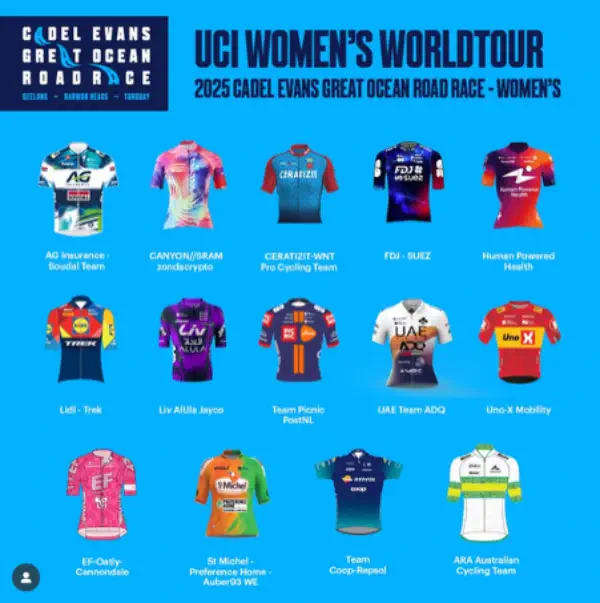
Source: 2025 Cadel Evans Great Ocean Road Race
Implications & Future Outlook Best-Case Scenario: A Sustainable Future

Imagine 2026: 15 financially sound teams, each with strong staff, fair pay, and real job security for riders. Sponsors flood in, attracted by stability. Broadcasters follow. Young riders can finally view cycling as a real career, not a gamble.

Stars like Demi Vollering and Grace Brown stay in the sport longer. Journeywomen riders get contracts with health benefits and pension plans. And races? More competitive than ever.

This is possible—but only if investment grows alongside regulation.

Worst-Case Scenario: The Big Squeeze

Now, the dark timeline: three or four teams collapse or demote to Continental level. The peloton shrinks. Sponsors hesitate. Media interest wavers.

The WorldTour becomes an elite club of manufacturer-backed super-teams. Innovation slows. Underdog stories fade. Ranks thin out, and races turn into predictable SD Worx vs. Lidl-Trek duels.

And riders? Many end up unemployed, or forced to race for minimal pay outside the top tier.

What’s at Stake for Riders and Teams

The implications are human. Riders signing their first pro contract in 2026 will do so knowing their job is stable. But others—especially those on the bubble—may find the door shut.

Teams must get smarter: leveraging media rights, fan engagement, and data analytics to prove value to sponsors. Some, like Lidl-Trek, are already ahead of the curve with YouTube content and TikTok strategies.

Others? They’ll need a miracle—or a wealthy angel investor.

The 2025 UCI Women’s WorldTour license renewal isn’t about who wins the most races. It’s about who can survive the most audits.

This moment is a crossroads: professionalize and stabilize, or risk fragmentation and decline. The new rules—equal pay, proper staffing, financial transparency—are bold, necessary, and long overdue. But they also come with a cost.

Will women’s cycling emerge as a truly equitable, sustainable sport? Or will we lose too much of what made it special in the first place?

One thing’s certain: the road to 2026 will be bumpy, emotional, and utterly fascinating. And whether you're in the peloton or on the couch, you won’t want to look away.

Because this isn’t just about bikes. It’s about building a future where every rider, every team, and every fan has a place at the table. No exceptions. No asterisks. Just fair play—in every sense.

Share with your friends
You May Also Like

October 10, 2025

Taking your medicines correctly ensures maximum effectiveness, prevents side effects, and keeps you safe

October 10, 2025

Taking your medicines correctly ensures maximum effectiveness, prevents side effects, and keeps you safe

Subscribe News

Get Exclusive Business Insights & Tips

Important
Say Hello

+61 404 641 288

7/107 Miles Platting Rd,
Eight Mile Plains QLD